
Tenhotin - an Offering for Immonen’s Great Stone
- Heikki Immonen
- 18.4.
- 4 min käytetty lukemiseen
A childhood memory from my grandparents' house
One of my childhood memories from the 1980s is a framed picture hanging on the wall of the large main room at my grandparents' house. It showed a huge boulder, with a house in the background, and some text underneath.
It was only much later, after I had become interested in my family roots and in Finnish folk tradition, that I learned what it was. My grandfather on my father’s side, Unto Immonen, had framed an article from Virittäjä, a Finnish scholarly journal, published in 1900 under the title “Immonen’s Stone.”

The reason it mattered to him was simple: the photograph had been taken on the land of his childhood home in the parish of Ruskeala, and the article told the story of Immonen’s Great Stone, also known as the Sacrificial Stone.
Tenhotin — an offering for the giants’ stone
The Virittäjä article gives this explanation of the stone’s origin:
“Legend says that a giant couple once lived where Immonen’s Stone now stands. One day, while the giant man and his wife were cooking porridge, a quarrel broke out between them. They began fighting, and then other giants hurled that great stone down on top of them. Others say that Ukko, the high god himself, threw the stone upon the quarreling couple. That is why it became a famous sacrificial stone.”

The article also describes the offerings once left at the stone: small bundles of alder twigs — seven twigs, each about three inches long, tied together with red thread. These were called tenhottimet.
The word tenhotin is unusual, but it likely connects to the Finnish word tenho, an old term associated with enchantment, charm, or magical force. There may be other layers of meaning, too. In ancient Finnish, the word leppä, alder in English, means blood.
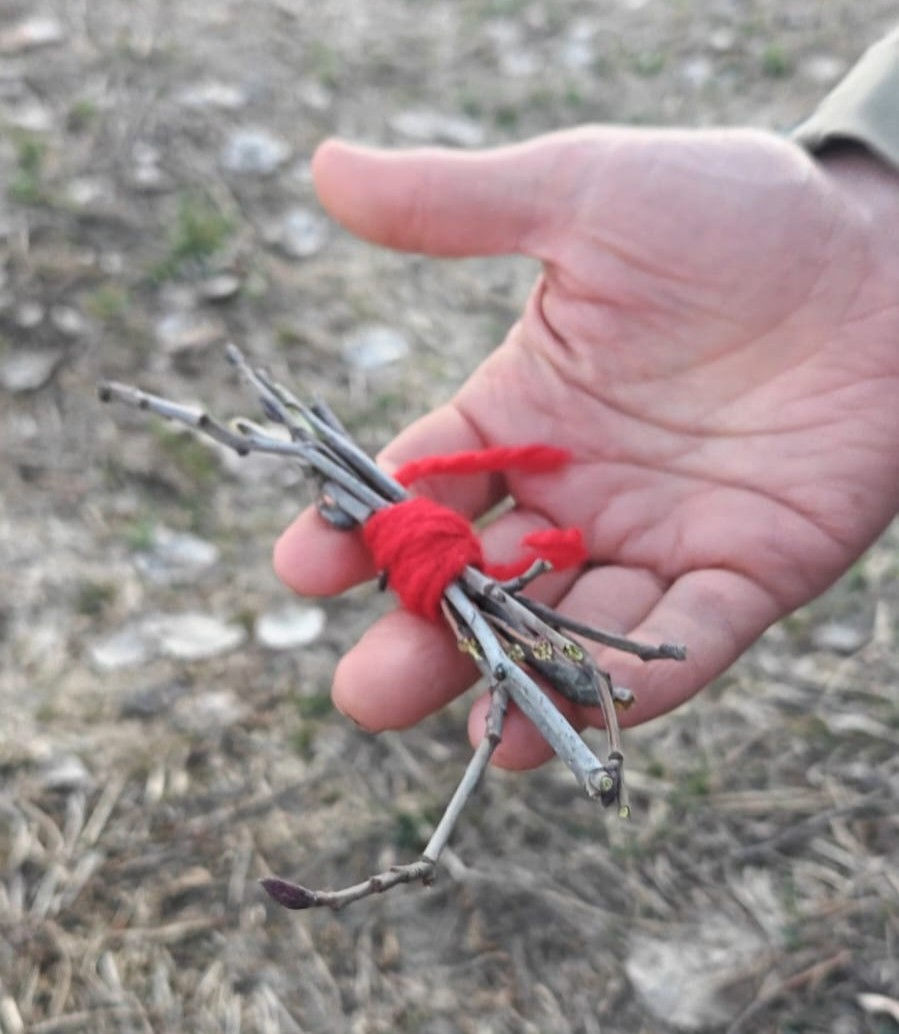
After discovering the story of the Great Stone, I began making these tenhottimet myself from time to time, following the description in the old article. Sadly, I never had the chance to ask my grandfather about his own memories of the stone.
I’ve made simple bundles, sometimes adding a small braid to the thread. I’ve also given them away as gifts and even as little souvenirs to friends from abroad.
What a tenhotin means to me
What could a practice like this possibly offer us today?
For me, the tenhotin has become a symbol of humility.
To leave an offering at a significant place in nature is, in a sense, a ritual of humility. Its purpose is to:
acknowledge the limits of your own understanding
help you act with that uncertainty in mind
open yourself to whatever the future may bring
and make you more receptive to your own intuition
In that sense, offering a tenhotin is a kind of ritual mindfulness. A way of stepping back from the assumption that your own thoughts, plans, and interpretations are always the most important thing.
In this symbolic act, a natural formation like Immonen’s Great Stone becomes the symbolic dwelling place of something beyond your control: the unknown, the Haltija spirit, the guardian, whatever name one wants to give it.
To me, it matters that such a place lies somewhere beyond the familiar and the comfortable. It should take some effort to get there. Moving through unfamiliar terrain has a way of sharpening awareness on its own, because the mind’s ready-made maps and routines no longer work so well.
You can even keep an offering at home for a while, letting it “charge,” so to speak. Then, when life presents a situation that lies outside your control, a moment when listening is wiser than forcing, the tenhotin can serve its purpose.
A personal memory
My strongest personal memory of the power of an offering goes back to an autumn when I was struggling with the central thread of my doctoral dissertation.
One dark, stormy autumn evening, I went out to a windswept headland and left a symbolic offering at the roots of a pine tree bent and hardened by the wind. It became an important moment of letting go, of loosening my grip and allowing my mind to settle.
The following night, I had a dream.
My interpretation of that dream became the central argument of the entire dissertation.
From Virittäjä (1900)
Below is the key excerpt from K. Killinen’s 1900 text on Immonen’s Stone:
“At the northern end of the village of Kontio-Leppälahti, on the edge of Immonen’s field, there is a large stone called the Sacrificial Stone, or Immonen’s Great Stone, to which offerings were still being diligently made until recent times. Beside it were often bundles of alder twigs, consisting of seven twigs three inches long, tied together with red thread; these were considered important tenhottimet in all difficult or obstructed matters. Women also brought milk, cow hair, wool, and other products of cattle and the land. In cases of serious illness, an image of the sick person was made from a block of wood or from clothing and taken to Immonen’s Stone. Love magic, too, was practiced using human figures. Whenever sowing began, grain had to be taken to the stone as an offering. The best times for sacrifice were Sunday morning before sunrise and Thursday evening after sunset. For a long time Kirsti Toivanen served as the stone’s priestess; through her the offerings were made, and she, like an oracle, conveyed the answers given by the spirit.”
“Legend says that a giant couple once lived where Immonen’s Stone now stands. One day, while the giant man and his wife were cooking porridge, a quarrel broke out between them. They began fighting, and then other giants hurled that great stone down on top of them. Others say that Ukko, the high god himself, threw the stone upon the quarreling couple. That is why it became a famous sacrificial stone.”


